

June 18, 2026
WINNIPEG – In a letter to the Canadian Museum for Human Rights (CMHR) Thursday, B’nai Brith Canada outlined serious flaws in the process leading to a coming exhibit relating to the Israeli Palestinian conflict.
“A publicly funded national institution must treat affected communities fairly, engage in meaningful consultation where it has represented that it will do so, and conduct its decision-making process in a manner that is transparent, balanced and consistent with its mandate,” the letter states.
A full copy of the letter can be accessed here.
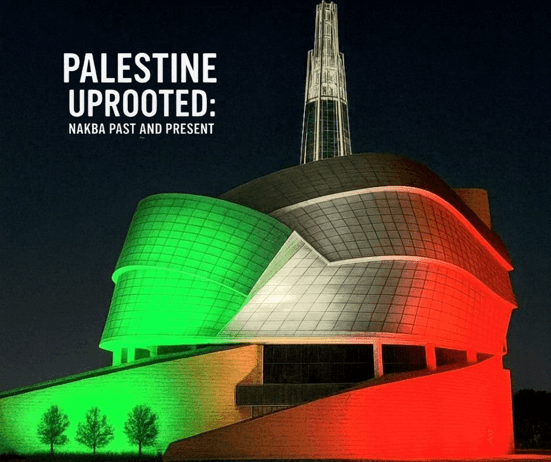
The exhibit, “Palestine Uprooted: Nakba Past and Present,” is set to open June 27.
B’nai Brith Canada has, on multiple occasions, urged the Museum to engage in meaningful consultations with the Jewish community.
This is because the contents of the exhibit – the details of which remain unclear – have the potential to promote revisionist, one-sided narratives about the Arab Israeli conflict.
In the letter, B’nai Brith Canada stated that it “expects” CMHR to undertake the following:
- Immediately suspend and defer the opening of the Exhibit, currently scheduled for June 27, 2026, pending the completion of proper consultation;
- Disclose, in writing, the identity of all organizations and individuals that the Museum consulted or engaged in connection with the development of the Exhibit, and the nature and extent of that engagement;
- Commit, in writing, to an open and good-faith dialogue and a meaningful consultation process with B’nai Brith Canada and the broader Jewish community in respect of the Exhibit and its accompanying materials, on a defined and reasonable timetable; and
- Preserve, and refrain from destroying, deleting or altering all documents and records relating to the conception, development and decision to proceed with the Exhibit, including records concerning any advisory body and the Museum’s community-engagement process.
B’nai Brith further contends that “confidence in the current governance structure has been materially affected,” and that, in consequence, “meaningful” changes must be made at the level of the Museum’s Board of Directors.
“The Arab Israeli conflict is a complex and deeply contested chapter in Middle Eastern history,” said Simon Wolle, B’nai Brith Canada’s Chief Executive Officer. “Public discussions of the conflict often involve differing interpretations of historical events, identities, and political movements, including Israel and Zionism.
“We are concerned that the CMHR exhibit may not provide sufficient context for some aspects of this history, and that, as a result, it could contribute to misunderstandings regarding Israel, Zionism, and the Jewish community. In the current climate, presentations of this subject matter may inadvertently reinforce existing misconceptions or contribute to broader social tensions, including antisemitism.”
For example, many narratives about the Arab Israeli conflict fail to account for the persecution and, in some cases, outright expulsion of Jews from Arab lands, during the events of 1947-1948 as well as in subsequent decades.
“It is also not clear to us whether the Museum included credible historians, with expertise on the Arab Israeli War of 1948, during its consultations,” Wolle said. “Above all, the Museum’s lack of transparency is unacceptable considering its mandate, its obligations pursuant to the Museum Act, and its important role in our society.”