

November 25, 2025
WINNIPEG – We are urging the Canadian Museum for Human Rights (CMHR) to consult Jewish groups, including B’nai Brith Canada, before moving ahead with its plan to curate an exhibit related to the Arab Israeli war of 1948.
“We are the oldest human rights organization in Canada, and we should have a seat at the table,” said Dr. Ruth Ashrafi, B’nai Brith Canada’s Regional Director for Manitoba and Saskatchewan. “This exhibit centers around a contested topic and the way it is presented will have a real impact on Jewish Canadians.”
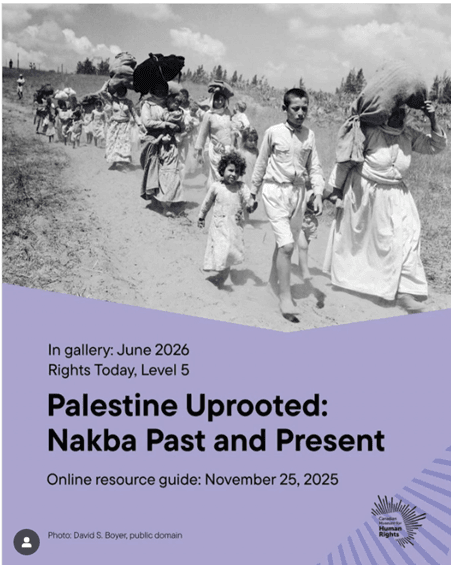
During the past decade, CMHR has faced sustained pressure from various groups to create an exhibit dedicated to the Nakba, Arabic for “catastrophe,” a term used in many Palestinian perspectives on the conflict that created the State of Israel. In December 2023, protesters occupied the museum and demanded it “commemorate” the Nakba and other human rights abuses Israel is alleged to have perpetrated against Palestinians.
In response to media inquiries during the December 2023 incident, a spokesperson for the CMHR said that it had decided to collaborate with Palestinian Canadians to develop a gallery that would showcase, in their words, “the human rights violations Palestinians experience every day.”
B’nai Brith Canada has, in multiple letters – including a 100-page historical and legal analysis by prominent human rights lawyer David Matas, who is also B’nai Brith Canada’s Senior Legal Counsel – and meetings with CMHR staff, raised concerns about the proposed curation. The CMHR, in response to our last exchange, said it would remain in contact with our organization, yet it has not answered us since then. It has also failed to disclose which Jewish organizations, if any, it has consulted thus far. It remains unclear if museum officials held appropriate discussions with credible historians or Jewish and Israeli Canadians.
In our communications with the CMHR, we have warned that exhibiting one narrative at the expense of others would inflame controversy and contribute to political turmoil. Since the outbreak of the Israel-Hamas war in 2023, which has fueled antisemitism and violent extremism in Canada, our concerns about the way in which the proposed CMHR exhibit might be framed have grown more urgent.
“We have asked to be included in the CMHR’s consultations,” Dr. Ashrafi emphasized. “CMHR said it would get back to us, but it never did. The Museum should seek to provide proper historical context in depictions of such a polarizing issue, which is a subject of controversy in the present day. Otherwise, it is engaging in one-sided politics, not history.”
The CHRM has deflected from criticism by stating it committed to the Nakba exhibit “long before” the Oct. 7, 2023, Hamas-led terrorist attacks on Israel, arguing that, although its exhibits are products of history, its galleries would “never be able to capture every element and experience of human rights.”
At the same time, the Museum has not responded to suggestions from the Jewish community that, for such an exhibit, it would be reasonable to include, for example, the stories of the 850,000 Jews who were uprooted from parts of the Middle East and North Africa during the late 1940-1970s.
“A public museum such as the CMHR has a particular mandate in our society,” said Simon Wolle, B’nai Brith Canada’s Chief Executive Officer. “Given the title of the proposed gallery, and the lack of consultation, we are concerned that it will sideline the voices of Jewish Canadians and promote revisionist narratives.
“There is still an opportunity for CMHR to change course – we urge the CMHR to answer our calls and collaborate with us to ensure that all its curations are consistent with its mandate to educate the public about human rights and the lived experiences of all Canadians involved in these issues, past and present.”